Supporting a food retailer’s mission to decarbonise their environment
Introduction
The UK food sector generates roughly 35% of national greenhouse gas emissions but many major supermarkets are targeting net-zero direct operations.
Heating and refrigeration are essential requirements for supermarkets but with a high reliance on fossil fuels from ageing commercial gas boilers and energy systems, usage is high as well as high spend on cost and a significant imprint on the carbon footprint. Food retailers are having to act to make a positive difference to their green targets.
Arcade has supported a programme of mechanical works for a food retailer at their branches across the UK. The aim was to lower their carbon usage and move to more energy-efficient operations.
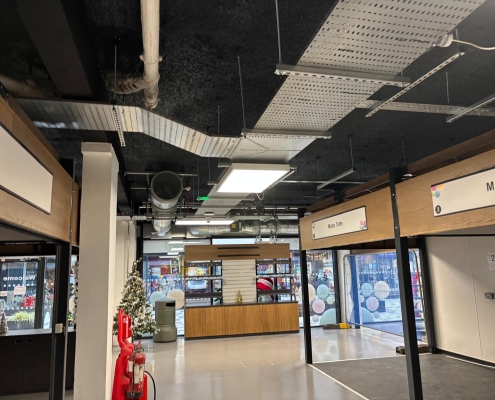
The projects have combined significant changes to heating and refrigeration infrastructure with the practical challenge of completing complex mechanical installations within tightly controlled programmes, often while stores remain open to customers.
Challenge
Decarbonising retail environments, many of which have been in operation for decades, is more than replacing individual pieces of equipment. As well as a heavy reliance on fossil-fuel heavy gas-fired boilers to provide heating and hot water, central refrigeration packs that serve chiller cabinets contain large quantities of refrigerant with a relatively high Global Warming Potential.
Across the stores, the previous refrigeration arrangement caused a resilience issue. Multiple cabinets connected back to a central refrigeration pack, so any issue with the pack would cause the chillers to fail, taking out a number of refrigerators in one go.
As systems have developed, heating, refrigeration, ventilation and hot water systems can all now work together but for this project, changing the technology was only one part of the challenge.
These store refurbishments were to be delivered within an eight-week deadline while working in a live store environment. Disruption needed to be kept to a minimum while installing major new mechanical infrastructure around customers, store teams and other contractors, maintaining existing services until each planned changeover could take place.
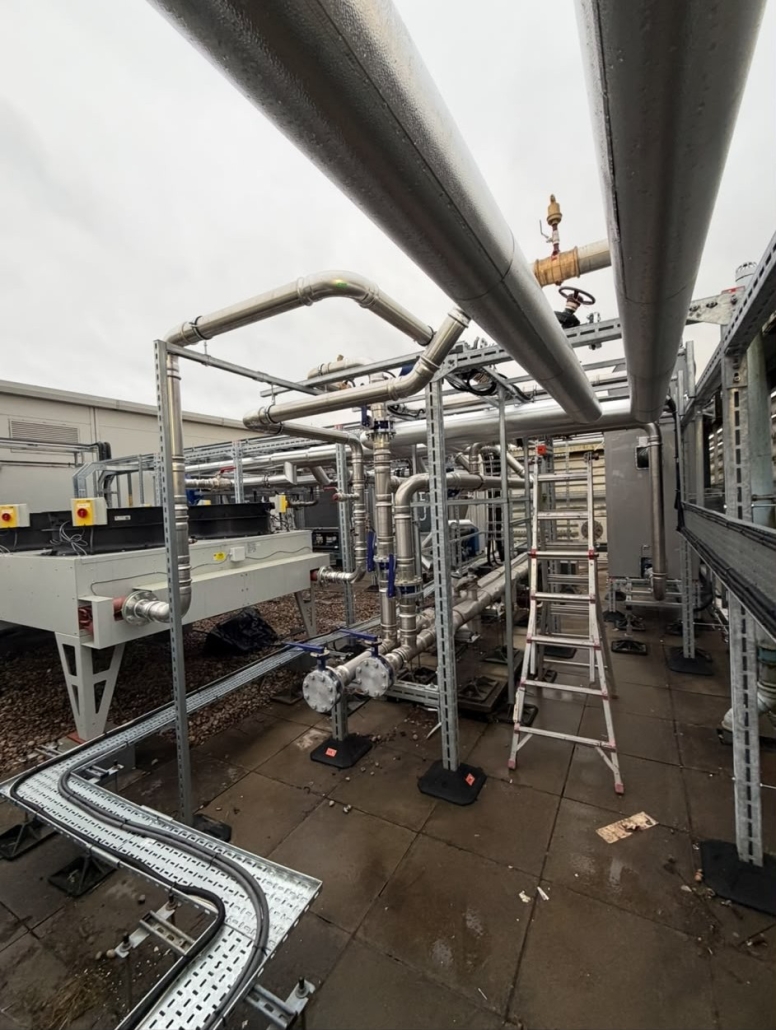
For some stores this included installing up to four kilometres of large-bore pipework through live environments.
Solution
Our approach brings refrigeration, heating and heat recovery together as a more integrated system.
Rather than relying on a large central refrigeration pack, individual refrigeration packs are positioned locally on the chiller cabinets. This substantially reduces the quantity of refrigerant required, and in turn, reduces the Global Warming Potential.
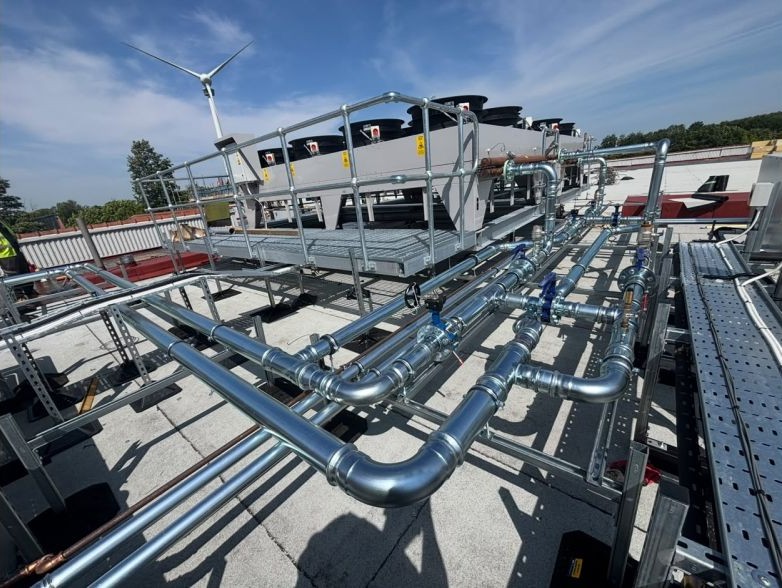
A chilled water circuit removes heat from the refrigeration equipment and dry air coolers installed at roof level, using ambient outside air as part of the cooling process.
But rather than simply rejecting all of the heat captured by the water, the system creates an opportunity to reuse it.
Check out more of our heat recovery work
Warmer water returning from the refrigeration equipment is now passed through a heat pump, extracting the energy and raising its temperature, so it can contribute to the store’s heating and hot water requirements, removing the reliance on fossil fuels. Water returned at approximately 27 °C could be reheated to around 70 °C.
Existing gas boilers could then be removed and the gas supply capped. Where additional capacity was still required during particularly cold conditions, much smaller boilers could be retained as backup instead of being the primary source of heat.
Our mechanical works have also included associated Variable Refrigerant Flow air-conditioning replacements and ventilation works, allowing other ageing infrastructure to be addressed during the same programme.
Delivering all of this within an operational retail environment required meticulous planning.
Major equipment such as heat pumps and dry air coolers had to be craned onto store roofs at pre-determined points in the programme which meant that installing, testing, flushing and readying pipework before each piece of equipment arrived.
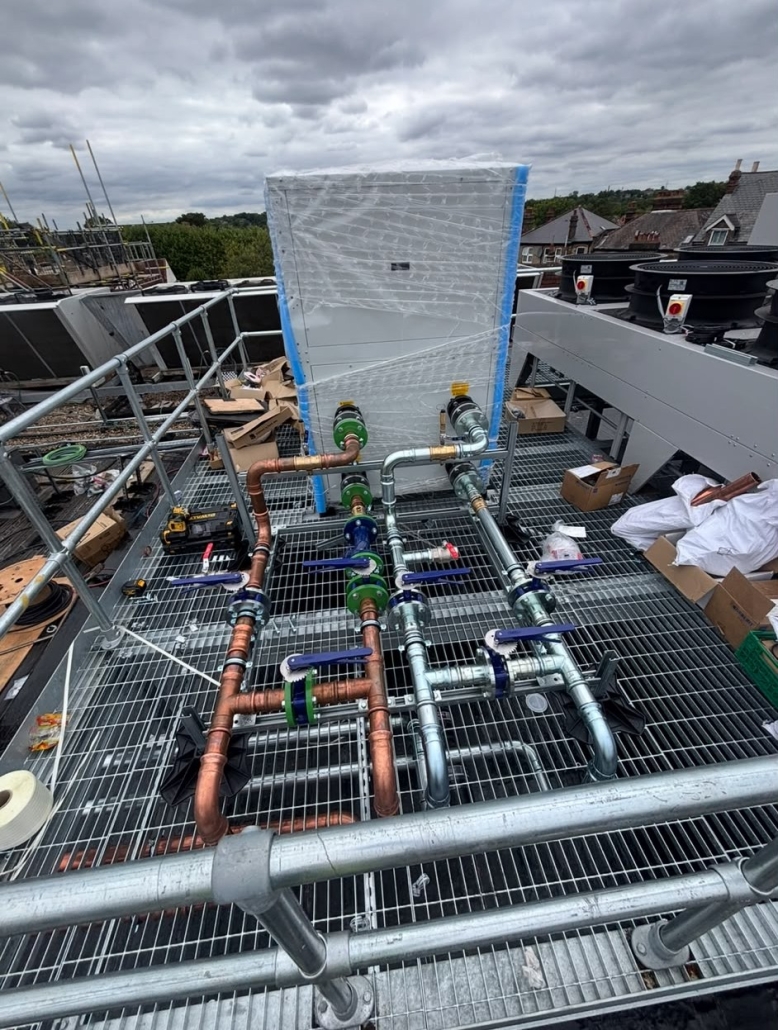
Chiller changeovers could also be restricted to a single overnight window. Our teams would enter the store after trading hours, complete the planned works and remove equipment from working areas before customers returned the following morning.
With day and night teams and supervisors working across the programme, the projects required almost continuous activity across the eight-week delivery period.
Result
The programme has helped the retailer’s stores move away from mechanical systems with a high reliance on fossil fuels to an approach that captures waste heat from the new refrigeration process and distributes it across the store for heating and hot water. This is a strong example of how lower-carbon technologies reduce energy use and cost.
The revised refrigeration setup also reduces the amount of refrigerant required making a much lesser impact on the Global Warming Potential and provides greater resilience by removing the dependence on one central refrigeration pack serving multiple chiller cabinets.
These projects demonstrate our ability to deliver substantial process-led mechanical installations safely and efficiently within demanding live environments.
Success depends on several factors: installing new systems, sequencing several kilometres of pipework, plant deliveries, testing, commissioning and overnight changeovers around the needs of an operational store.
This experience has enabled us to support this programme of improvements and others over a number of years and in several locations all across the UK.
Conclusion
Decarbonisation is on the priority list for many businesses, not just leading retail environments.
It relies on a contractor understanding how multiple systems interact, and where energy is already being generated, where it can be captured and used more effectively elsewhere.
This programme demonstrates that principle in practice.
We combine mechanical and process engineering expertise with the planning, coordination and safe delivery needed to make complex change possible within a live environment.
If you have operational targets to reduce or eliminate your carbon emissions, we are your experienced mechanical team who can help you understand what’s required and how to implement. Find out more and get in touch today.